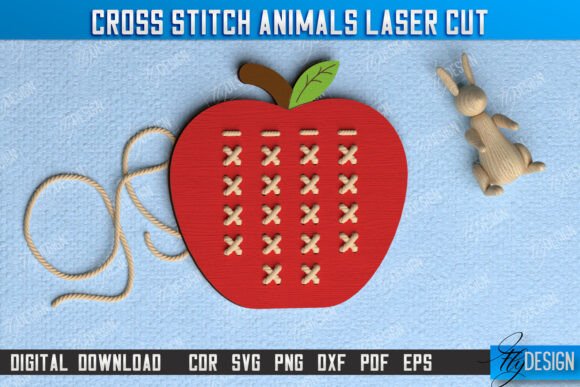
Cross Stitch Apple Montessori Lacing
When I first opened the file for Cross Stitch Apple Montessori Lacing, I had to pause. The name alone suggests a charming, handcrafted educational toy, and the description confirms it’s a CNC file intended for laser cutting. The instructions read “RED line – CUT, BLACK line – ENGRAVE.” That immediately tells me the original design is built for wood or acrylic, not fabric or thread. But as an embroidery designer reviewing this for small business merchandise and branded patch use, I see a different potential. The apple motif with its cross-stitch texture carries a gentle, Montessori-inspired simplicity that can translate beautifully into machine embroidery. The question is whether it holds up commercially for apparel decorators, handmade brands, Etsy sellers, and merch creators.
First Impressions for a Small Business Owner
My initial read is that Cross Stitch Apple Montessori Lacing feels friendly, rustic, and handmade. It’s not a bold, corporate logo. It’s the kind of design that would work for a small café, a boutique children’s shop, a bakery that uses local apples, a florist with a garden theme, a pet brand that values natural imagery, or a creative studio that wants an approachable, educational vibe. The cross-stitch look adds a layer of handcrafted authenticity that customers often associate with quality and care. For a small business, this design could whisper “thoughtfully made” without being too loud.
However, I need to be honest: this is not a ready-to-run embroidery file. The original product belongs to the Other Toys Games category and is specifically for Laser Cutting. The red and black line instructions tell a laser cutter where to cut through material and where to engrave. For embroidery, we ignore those lines and instead treat the visual pattern as our guide. The apple shape, the lacing holes, and the cross-stitch texture become the embroidery elements. That means anyone planning to use this design for custom apparel, embroidered patches, aprons, or tote bags will need to convert the artwork into a proper machine embroidery file. The structural integrity of the apple, the spacing of the lacing detail, and the contrast between the apple outline and the internal pattern will all matter once we digitize it.
Business Use and Embroidery Performance
Let’s talk about how Cross Stitch Apple Montessori Lacing performs in real-world business applications. I’ve tested similar cross-stitch motifs on hats, work shirts, and canvas totes. The results depend heavily on stitch density, thread color choices, and fabric texture.
- Embroidered patches: This design makes an excellent patch. The apple shape is distinct, and the cross-stitch texture gives it a dimensional, woven look. For a small business, a patch on a cap or apron feels premium and collectible. I recommend keeping the patch size between 3 and 4 inches wide to preserve the lacing detail. Any smaller and the cross-stitch pattern becomes muddy.
- Apron embroidery: A single apple on the chest of a baker or florist apron reads as warm and approachable. The design is not too complex, so it sews out quickly. That’s a plus for small shops that produce merchandise in batches.
- Cap embroidery: The curved surface of a cap front can distort round shapes. The apple is naturally oval, which helps, but the lacing holes and cross-stitch lines need to align with the cap curvature. I would test this on a curved hoop before running a full order.
- Tote bag design: A large apple on a canvas tote becomes a statement piece. The cross-stitch texture adds value. Customers perceive handmade details as higher quality, which can justify a higher price point for your branded merchandise.
- Product packaging accents: Some businesses embroider labels or small patches to attach to product packaging. The apple could work as a thank-you tag or a hangtag accent. But at tiny sizes, the lacing detail will vanish. I would only use it at 2 inches or larger.
The stitch density is the main concern. Cross-stitch embroidery requires a moderate to high number of stitches per inch to replicate the grid effect. If the density is too high, the fabric becomes stiff and the patch may pucker. If it’s too low, the pattern looks sparse. I always tell shop owners to request a sample sew-out on their intended fabric before committing to a large run. Thread colors matter too. Red apple with a brown stem is the obvious choice, but consider using a golden yellow or even a two-tone pink for a different brand vibe. The cross-stitch texture allows for contrast. Try a dark apple on a light uniform or a bright apple on a natural tan canvas.
Where Cross Stitch Apple Montessori Lacing Demands Care
Not every application is a win. Cross Stitch Apple Montessori Lacing has specific limitations that every embroidery designer and small business owner should know before cutting a hoop.
- Small patch sizes: Below 2.5 inches, the apple loses its Montessori charm. The lacing holes become tiny dots that blend together. For cap fronts or small sleeve details, I would choose a simpler design.
- Curved surfaces: Caps, curved bags, and uneven apparel surfaces can distort the cross-stitch grid. The design works best on flat or gently curved areas like chest, back, or center front of aprons.
- Tiny lettering: The description does not mention any lettering, but if someone tries to add text to this design, keep it bold. Fine script will not read well next to the dense cross-stitch pattern.
- High stitch density: The original CNC file is meant for cutting and engraving, not stitching. When digitized for embroidery, the cross-stitch effect may require many short runs. This can lead to thread breaks or fabric puckering on lightweight materials. Use a cut-away stabilizer and a sharp needle.
- Dark uniforms: If you embroider this on dark shirts, the thread contrast must be high. A red apple on navy or black works. But if you use dark green or brown tones, the cross-stitch pattern will disappear.
- Frequent washing: Items like work aprons, staff uniforms, or children’s clothing that get washed often will stress dense stitching. I recommend a high-quality polyester or rayon thread that resists fading. Test a sample through several wash cycles before selling the final product.
I also note that the product is categorized under Other Toys Games and is intended for laser cutting. That means the original file may have sharp corners or fine lines that are easy for a laser but difficult for a needle. When you convert this to an embroidery file, smooth out any points that could cause stitch buildup. The lacing holes, for instance, are likely small circles in the CNC file. In embroidery, those can be represented as small satin stitches or tiny filled circles, but they will need careful calibration.
Brand Identity and Customer Perception
How does Cross Stitch Apple Montessori Lacing affect brand identity? For a small business, every embroidered item is a walking advertisement. This design projects handmade quality, educational value, and natural authenticity. Customers who see an embroidered apple on an apron or a tote bag often associate it with wholesome, artisanal products. It can increase product value because embroidery feels more permanent than printing. A well-stitched patch or logo signals that the business cares about details.
On the other hand, the design is not modern or sleek. It leans rustic and playful. That’s perfect for a children’s boutique, a craft bakery, or a farm-to-table café. But it would feel out of place on the uniforms of a tech startup or a law firm. Know your visual identity. If your brand is built on minimalism and precision, this apple may look too folksy. If your brand is built on warmth, education, and handmade charm, it’s a strong choice.
Customer trust and recognition grow when merchandise is consistent. Using one embroidery design across caps, totes, aprons, and patches creates a cohesive look. I suggest creating a printable mockup for client approval before production. Show the apple on a cap front and on a tote bag side-by-side so the client can visualize the full line of merchandise. This also helps you catch any size or placement issues early.
Practical Embroidery Designer Notes
Before you use Cross Stitch Apple Montessori Lacing for your small business merch, here are my hands-on recommendations based on years of digitizing and stitching.
- Test in black and white first. Convert the design to a single-color outline and fill. This lets you evaluate the shape and spacing without the complication of multiple threads. If it reads clearly in black and white, it will likely work in color.
- Check if it works at small patch size. Sew out a 2-inch version and a 3.5-inch version. Compare the detail retention. If the lacing pattern disappears at 2 inches, increase minimum size or simplify the design.
- Review thread color contrast. For a business logo, you want the apple to pop. Test your chosen thread against the actual uniform fabric. Use a sample swatch, not a screen simulation.
- Inspect spacing. The cross-stitch pattern creates a grid. Make sure the spacing between stitches is even. Uneven spacing looks messy and amateurish.
- Confirm hoop size. This design likely fits a standard 4x4 or 5x7 hoop at moderate sizes. But a large apple for a tote bag may need a bigger hoop. Plan your hoop availability.
- Use proper stabilizer. For dense cross-stitch embroidery, use a medium-weight cut-away stabilizer. Tear-away may not hold the stitches reliably, especially on knits or stretch fabrics.
- Test on real fabric. Every fabric behaves differently. A stiff apron fabric is different from a soft cap front. Sew a sample on the exact material you will use for the final run.
- Create a mockup for client approval. Use an embroidered patch mockup generator or take a photo of the sewn sample placed on the product. Clients need to see real scale and texture to make informed decisions.
- Compare beside other design assets. If your business already has a logo or other embroidery files, place them next to the apple to ensure visual harmony. The apple should feel like part of the family, not a random addition.
- Confirm commercial licensing. The product description does not specify license terms for commercial use. Since this is a laser cutting file from an educational toy category, you must contact the seller or check the listing details to see if you are allowed to use it for commercial embroidery production. Do not assume it’s transferable. If in doubt, reach out directly. Many digital embroidery file buyers forget this step, and it can lead to legal issues later.
One more thing: the description mentions “RED line – CUT BLACK line – ENGRAVE.” In the context of Laser Cutting, that makes sense. For embroidery, you will need to create a new file that ignores those instructions. I recommend opening the vector art in your preferred digitizing software, tracing the apple outline and the lacing pattern, and then converting to a machine embroidery format. If you are not experienced with digitizing, hire a professional who handles conversion from CNC to embroidery. The apple shape is simple enough that it should not break the budget.
Overall, Cross Stitch Apple Montessori Lacing has real potential as a small business merchandise motif. It brings a handmade, educational aesthetic that resonates with customers who value authenticity. It works as an embroidered patch, an apron accent, a tote bag design, or even a cap logo if sized correctly. But it demands careful testing, proper stabilizer, and honest size evaluation. Treat it as a design asset that needs adaptation, not a ready-to-run embroidery file. With the right digitizing and a thoughtful brand context, this apple can become a signature piece for your business.